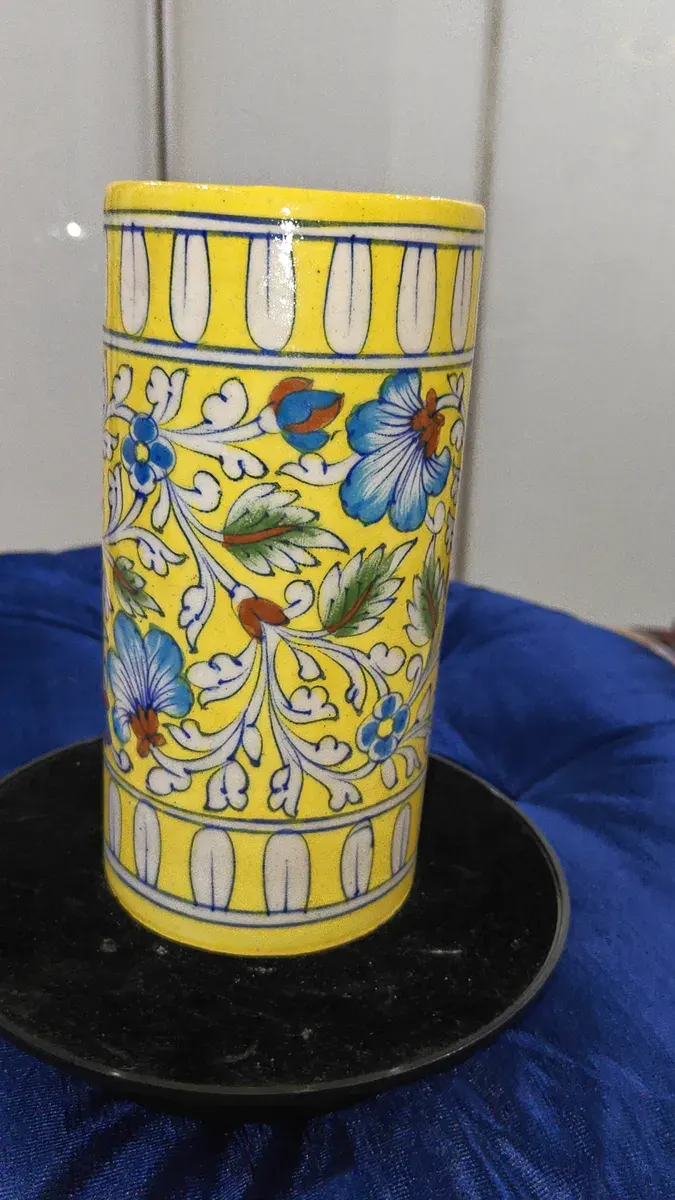
Object
Why it exists
Jaipur Blue Pottery is a traditional and highly distinctive clay free form of glazed pottery originating from Jaipur, Rajasthan. It is widely recognized for its vibrant blue colors, intricate hand-painted designs, and its unique, composition.
Process
How it is made
The Jaipur Blue Pottery Making Process
The creation of Jaipur Blue Pottery is a labor-intensive, multi-stage craft that uniquely relies on a clay-free dough. Here is the step-by-step manufacturing process:
1. Dough Preparation (The Clay-Free Base)
Instead of traditional river clay, artisans prepare a unique dough. The mixture is created by combining ground quartz stone powder, powdered glass, Multani Mitti (Fuller's earth), borax, natural gum, and water. This is kneaded thoroughly to create a pliable material.
2. Molding and Shaping
The dough is rolled out into a flat sheet, similar to a pancake. It is then carefully pressed into open Plaster of Paris (PoP) molds to achieve the desired shape, such as a plate, bowl, or vase. A fine powder, often wood ash, is dusted inside the mold beforehand to prevent the dough from sticking.
3. Sun Drying
The mold containing the pressed dough is left to dry naturally in the sun for 1 to 2 days. Once the material has partially hardened and firmly taken the shape of the mold, it is gently removed.
4. Finishing and Smoothing
After complete drying, the raw piece usually has rough, uneven edges. Artisans use a file to carefully chip away excess material. The entire surface is then rubbed with sandpaper or a special stone to make it perfectly smooth. A very thin liquid coating of the dough mixture may be applied to fill any tiny pores or cracks.
5. Designing and Hand-Painting
The smooth, dried surface acts as a canvas. Artisans sketch and then hand-paint intricate traditional motifs—such as florals, arabesques, or animals—directly onto the piece using fine brushes.
Cobalt oxide is applied to create the signature deep blue color.
Copper oxide is applied to create turquoise.
Other metal oxides may be used for modern additions like yellows, greens, or pinks.
6. Glazing
Once the painted design has completely dried, the piece is coated with a liquid glaze. This glaze is typically a "frit" made from a heated and powdered mixture of glass, borax, and zinc oxide. The piece is swiftly dipped into this mixture, which will give it its characteristic glossy, glass-like finish after firing.
7. Firing (Single Bake)
The glazed pieces are carefully stacked inside a traditional closed kiln. Unlike high-fired ceramics, Blue Pottery is fired only once at a relatively low temperature, usually between 800°C and 850°C, for about 4 to 5 hours.
8. Cooling and Unloading
The kiln must be left sealed to cool completely, which typically takes two to three days. Opening the kiln too early causes a sudden temperature change that will crack the fragile pottery. Once fully cooled, the finished pieces are unloaded, revealing their vibrant, glossy colors.
Origin
Blue Pottery from Jaipur GI Tag no 66